Not too long ago I wrote about my efforts to determine whether my Gerald ancestors did indeed come from Ireland as I’ve always been told. I only recently discovered that not all of the descendents of Gabriel Gerald agree on where his father, James Gerald, came from way back in the 1700s.
The story as it has been handed down to me is that our first Gerald grandfather to live in this country came from Ireland changed his name from Fitzgerald to Gerald at some point along the way. Last summer, though, I blogged about a distant relation who was somewhat infamous, and this drew in some living distant relations to the comment section on my blog.That’s when I learned that some branches of the family think that our common ancestor came from France instead of Ireland.
Regardless of which camp I fell into, I had the same problem everyone else had in backing up my story. We have no paper trail. Our James Gerald is a genealogical dead end. No one has been able to find records of who his parents were or where they might have lived.
So I decided to go after the question from the scientific approach, and my brothers were gracious enough to help me out. They all chipped in to have a Y-DNA test done through www.familytreedna.com. We had the 67 marker test done, which is what I had been told we needed if we wanted to prove family matches.
The results of this test were very interesting but not necessarily conclusive. I did believe after viewing the matches that we were leaning toward Ireland as more likely than France as the place of origin. Still, we didn’t have enough family matches and we didn’t have close enough family matches to fill in any real genealogical gaps.
Eventually, I think the right person will come along and take the same test and show up as a conclusive match in a way that will help us fill in the family tree. I could have just sat back and waited a few years for that to happen, but I decided to order more tests instead.
I ordered a deep clade test to find out our haplogroup. With the original Y-DNA test, we were told the haplogroup was R1b1a2. This didn’t prove anything because it is the haplogroup of 80% of Europe. It’s also just a general category. Additional testing could narrow it down, and that’s what the deep clade test was for.
Today, I got the first of the results from the deep clade test, and the haplogroup is now R1b1a2a1a1b4. This is much more specific. It is a haplogroup that is primarily associated with England and Ireland.
The tests are not complete yet. It should take about another month to find out if they are able to narrow down any more than this.
In the meantime, all we can say is that this is at least some evidence to support the Irish ancestry claims. It does not rule out French ancestry. However, R1b1a2a1a1b4 is far more common in Ireland than it is in France. By that I mean it shows up in up to 10% of the population in France and in more than 50% of the population in Ireland (if I understand correctly).
Some people seem to associate R1b1a2a1a1b4 with Celtic ancestry. I would have to read more about it before I could comment on how solid that theory might be, but it should be interesting to find out.
R1b1a2a1a1b4 is all I know today. I will update again when the tests are complete to let the two people who might be reading this know whether or not we matched any sub-categories of this group.
If anyone has any information about R1b1a2a1a1b4, I would be very interested in reading it.
If you are a male descendent of Gabriel Gerald, and you are interested in having your own Y-DNA tested, I’d very much appreciate it if you would share your results with us. One way we can solidify our evidence is to find out if my brother’s results are repeatable in other branches of the family.
And if you are simply interested in conducting your own family DNA research, I do recommend the site www.familytreedna.com. I also suggest that you do what we did and have several people chip in to pay for one test. The tests are expensive, but all of the brothers in a single family should all have the same Y-DNA, and if they don’t, this might be something you don’t want to know. Just chip in and have only one of them tested.
I’ll post more when I know more. Meanwhile, if you catch me mumbling weird strings of numbers and letters, you’ll know I’m reading another DNA book trying to figure out how all of this works.
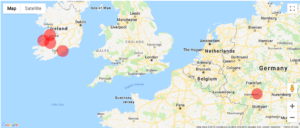

Hej Sharon. I recently received my deep clade results/ Y-DNA (FamilyTreeDNA) and they report the same R1b1a2a1a1b4. Interesting, and somewhat confusing, since I have done research back with my DANISH roots. I found grandfather Philip from Copenhagen, g-gf Christian and his father Jørgen from Thurø (near the island of Fyn) and his father (my gg-gf Christian) from north Jutland. All other maternal gfs of my father were also from this Thurø region (a small island south of the larger Fyn/Funen…home of HCAndersen).
My father’s mother’s lineage was from Ireland… Gormley. As far as we know g-gf Frank was a cop in Dublin. My grandmother’s mother’s side we think was Scot-Irish (Lynch)…and maybe a bit of English.
So I ask, ”What gives??” Ha!
Your thoughts, please.
Thanks, Bill
Bill,
I have two strange markers for R1b.. 390=22 and 388=13. those are most commonly see in I1, or Norse. One opinion is that it is the result of recombination. But, I had looked at Danish roots as well.
R1b1a2a1a1b4i
My male side y DNA from markers 12 to 111, comes up almost exclusively from Scottish groups in America and Haplogroup R1b1a2a1a1b4 in Scotland. The Scots came from Ireland so they have those markers. Anglo-Saxons and Jutes which is the dominate group in England immigrated to from Germany, Denmark and Netherlands. They mixed with Celtic, Pict s and Scots, in England and Scotland. The Norman invasion brought, French, Jutes and Anglo-Saxon bloodlines into mix to British Isles. So that is why everyone from that H-group can be from British Isles with markers from Northern Europe. The British, Irish, and Scots are Celtic and Germanic , some French.
Norman,
I am also R1b1a2a1a1b4 (actually Z253+**) with most distant ancestor coming from Down, Ireland around 1800. Was always curious if there was a Scottish connection.
I’m N1931 with Family Tree DNA, PWS4C on ySearch.
Contact me if you’d like to do some ancestor record comparisons.
Thomas
Dont forget about the forced relocation of lowland Scots into the Ulster area of Ireland starting about 1600, for the English Plantation Movement.
Also, many Scots returned to Ireland as mercenaries.
Dont forget about the forced relocation of lowland Scots into the Ulster area of Ireland starting about 1600, for the English Plantation Movement.
Also, many Scots returned to Ireland as mercenaries. Like the Mar clan
Hej igen Sharon. Just recently ‘signed up’ for the additional deep clade testing up to 67 markers… should be reporting back by mid October ’12… will let you know what they find…Bill Chr
http://en.wikipedia.org/wiki/File:Haplogroup_R1b_(Y-DNA).PNG
I recommend you check out the Yahoo group in DNA for L21. It is a group that is focused on the deep ancestry and sub groups of L21. There have been several recently discovered SNP’s downstream of L21. Df 13 is one of them with SNP’s now known as son’s and grandson’s of L21. L21 is the SNP for the current classification R1B1A2a1a1b4. With further testing you may be able to break down the classification to an even more refined grouping. There are messages and files here you should find very informative.
Just received an e-mail from FTDNA advising me that my deep clade results had been posted and have just found out that I have gone from R1b1b2a1b to R1b1a2a1a1b4!
This was a bit of a surprise as I’m originally from Madeira (Portugal) and from what I can gather R1b1a2a1a1b4 is normally associated with Celtic countries.
That being said, I know that prior to the Roman invasion of Iberia, a fair chunk of Spain & Portugal was settled by the Celts so I guess that’s probably why I’m a member of this Haplogroup?
Your family must have come down from Galicia. Id love for them to identify the Milesian line from there
My male cousin had his Y-DNA tested and the Haplogroup is R1b1a2a1a1a4. The surname is Longmore and we have traced the family back to around 1822 in County Cavan, Ireland. At that point we are stuck with no more paper trail. If anyone has ancestors Longmore or County Cavan, we would be interested in hearing from them.
I also tested R1b1a2a1a1a4 at FTDNA. As far as we can trace my GGrandfather Patrick Flood came from Forgney, County Longford; we believe his parents were Thomas Flood and Bridget McGauran/McGovern. We have a Flood DNA project at FTDNA and no matches amoung the 30 Floods that belong!
My father was from Co. Tyrone, Ireland. Test results to date show YDNA R1b1a2a1a1b4. Your questionable French connection could indicate that an ancestor served served in the French armed forces as thousands of Irish did over the centuries.
Good luck in your search. Also, if the original name was Fitzgerald then there is a Norman connection so your search may lead you in a circle.
MY 67 marker results came back from FTDNA last week. I too am R1b1a2a1a1b4. I was pointed to three closest ancestors all in Scotland circa 1780s, none with my surname (BROWN, traced back to early 1800s, all in London, England) but named IZETT/ISSET/IZAT. I have yet to work out where that leaves me! Any ideas?
Maybe Eisenmann? Don’t know how they got to Scotland but I have an Eisenmann ancestor that has that yDNA. http://www.ysearch.org/lastname_view.asp?uid=&letter=&lastname=Eisenmann&viewuid=69BSD&p=0
R-L21+ (the shorthand for R1b1a2a1a1b4) is the parent of SNP DF13+ which is said to be a couple of thousand years old. In turn DF13+ is the parent of SNP L513+.
Recommend to you a search of :
http://groups.yahoo.com/group/1113Combo/
and of :
http://www.familytreedna.com/public/R-L21-1113Combo/default.aspx?section=yresults
for the names and places associated with that haplogroup R1b-L513 (underneath of R1b-L21 / R1b1a2a1a1b4)
You may be able to collect useful information in terms of the names and places mentioned.
As a Rose of Kilravock Castle, Scotland I have tested as SNP L513+ which seems to be the terminal SNP known at present. Ancestry of the Roses of Kilravock begins in the 1200’s with Kilravock gained by the Roses/Ross/deRos through marriage. Prior to that they most probably were “of Geddes”, in the Scottish Highlands. Celtic origin is most likely. The surname Mascy/Massey/ appears as being identically associated with the Rose/Ross testees. and are likely of Norman/French origin.
See also http://www.familytreedna.com/public/rose (under Group G and subgroups)
Glad to speak further with anyone having an interest in the deep ancestry of these families.
George F. Rose FTDNA Kit 32119
I am R1b1a2a1a1b4 also.
My family story is that Robert Easley (Robet) was a French Huguenot. His family fled France and lived in England. He alone immigrated to VA Colony in c1675. I can trace the paternal lineage back to this time. A father and grandfather to Robert lived in France. I do have their names and locations only.
On my website: http://www.easleygenalogy.com I decided to believe the family documentation and anecdotal stories I heard from my grandfather. Considering that 10% of …b4 could come from France, I am holding out even though the DNA info points to Great Britain. I heard from a French person that attempting to test on 23andMe is a crime in France; therefore, the input from French lineage is blunted. I can visualize my immigrant Robert Easley living in England and then traveling to VA Colony. However, I’m ready to accept any truth in order to move on. Is the Easley surname familiar to any bloggers?
GEDmatch.com M210139 and I’m public on 23andMe.com
Warmest regards,
Sonia Easley
Sonia, I search of Find A Grave, Pike County, Mississippi, born before 1850, will give you a number of Easleys. The profile manager (an Easley himself, I can’t recall his name) may have information about contemporary family members who have taken the test. Happy Hunting!
My Haplo Group is alive and well in Northern Louisiana…Y’ALL. We are but merely present day custodians of our ancestors genes (R1b1a2a1a1b4*)
I haven’t had a DNA test done yet but found some of my ancestors who did and have that same Haplo Group R1b1a2a1a1b4. I was able to trace back to the 1300’s which took me to Scotland but My grandmother had always told me that we were Irish. Was never able to go all the way back to Ireland but its possible since that is what she always said. The origin of R1B1a2 is thought to likely have originated from Western Asia and was here in Neolithic times. I am assuming my ancestors after they made it to Ireland went to Scotland, Then England then US as records seem to indicate. Their Last name was Robertson.
My haplogroup is also R1b1a2a1a1b4. Makes sense, with a name like McGuire. I only recently confirmed that my Great Great Grandfather (Thomas McGuire) was born in County Mayo around 1819. We also know his older brother Patrick (b. abt 1815) was born there.
That’s about all I’ve got, but it’s much more than I had a few months ago.
Hi,
I can trace my maternal line back to Devon and the Norman invasion 1066. William was of Viking descendant (Danish) hence my french/scandinavian origins. However, my Devon/ Cornwall mtdna group is U5b2b which followed the south Med route out of Africa via northern Italy, Pyrenees (Catalan and Basque) up to the Cornish coast and in my case, and further on to Ireland for others.
I hope this helps.
My Martins were said to be Normans who came to England in 1066 with William the Conquerer, then to Ireland, then to Jamestown in Colonial Virginia. Our Y haplotype is R1b1a2a1a1b4. Our story fits many of those in this link, showing a connection to both France and Ireland. Our earliest known ancestors were Abram Martin born 1647 Virginia and Zachariah Martin 1698 Virginia, who moved to North Carolina. Our group at FTDNA is group 21 Martin.
For those with the R1b1a2a1a1b4 Haplotype whose ancestry seems to come from the Danish, Swedish and Norwegian areas, remember that the Viking raiders from those three areas and Iceland loved to capture Celts and sell them as slaves, or take them home as slaves. This importation of the R1b1a2a1a1b4 gene into Viking areas accounts for today’s occurrence of the Haplotype where we wouldn’t otherwise expect to find it.
R1b1a2a1a1b4 also know as r1b L21 is also very commun in Britanny if I believe the various Breton web sites on the subject
Britanny was supposedly populated by people from Cornwall back in th Vth century AD.
I am also stuck like yourself around the mid 1500 for lack of records. This is why I am trying a different route.
Cheers,
Michel